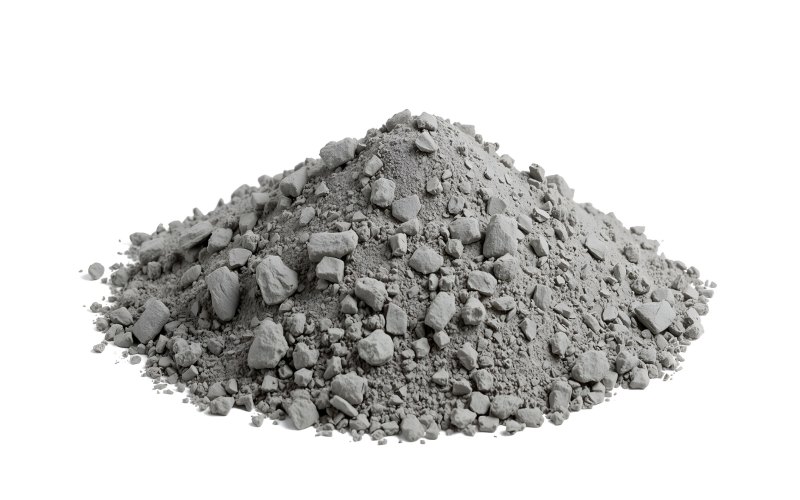
Refractory clays
KERACLAY is a major European producer of refractory clays, which are widely used in various industries. Refractory clays are a specific type of mineral known for their ability to withstand high temperatures, which is a key property for their use primarily in the ceramics industry, the production of fired slate, and fireclay products. Refractory clays are characterized by high thermal resistance and stability when exposed to extreme temperatures. These clays have a low content of impurities, such as alkaline substances, which contributes to their refractory properties.
Physical properties
- High resistance to temperatures above 1300 °C.
- Low alkali content, which minimizes deformation when exposed to heat.
- Good plasticity, allowing for easy forming.
- Suitable chemical composition for the production of refractory ceramics, shales, and fireclay products.
Packaging and shipping
- In dry state, crushed or micro-ground
- In bulk, in paper bags of 40 kg (20 pcs per pallet in shrink film), in big-bags of approx. 1 ton per pallet.
- Shelf life is unlimited in a dry environment.
- Since this is a natural product, slight deviations from the values stated in the technical documentation are possible.
Technical informative parameters
| Product | Refractoriness | Total shrinkage 1250°C (%) |
Water absorption 1250°C (%) |
Organic materials (%) |
Degree of plasticity (Gp) |
|---|---|---|---|---|---|
| W-special-J-TM | 172 | 13 - 14 | 8 - 9 | 1 - 3 | 3,8 - 4,4 |
| W-special-J-org. * | 175 | 13 | 11 | 3 - 5 | 3,6 - 4,0 |
| IBB * | 165 | 10 | 13 | 2 | 4,0 |
| WBS * | 175 | 14 - 15 | 12 | 3 | 4,0 - 5,0 |
* A micro-ground version of 0.063 mm is also available
Recommended clays
W-special-J-TM
Refractory claystone suitable for use as a raw material for fired shale (fired in a shaft kiln). Not used in ceramic casting materials due to its poor rheological properties.
W-special-J-org. (+ micro-ground)
Refractory clay with an organic content of up to 5%. It is used as a raw material for fired slate (fired in shaft kilns).
IBB (+ micro-ground)
Mixed porous clay. A mixture of low-plasticity and medium-plasticity clay. It is very suitable for products with a light porous body and for the production of refractory goods (e.g., glass pans). It is not suitable for fast firing.
WBS (+ micro-ground)
Refractory clay that fires white. It is suitable for products requiring high refractoriness (plasterboard, fireclay goods).